
In the Canopy of the Barito, the Forest’s Architect Endures
A Reflection for World Orangutan Day from the South Barito Kapuas Project – PT. Nusantara Raya Solusi
by Riko
It is 9:38 on the morning of 22 April 2026. Deep in the swamp forests of the Barito, a camera trap keeping its silent vigil among the trees records a shaggy figure moving unhurried across the forest floor. There is no thunder, no spectacle. Only an adult Orangutan walking calmly through a home its ancestors inhabited long before humankind ever coined the word “conservation”.
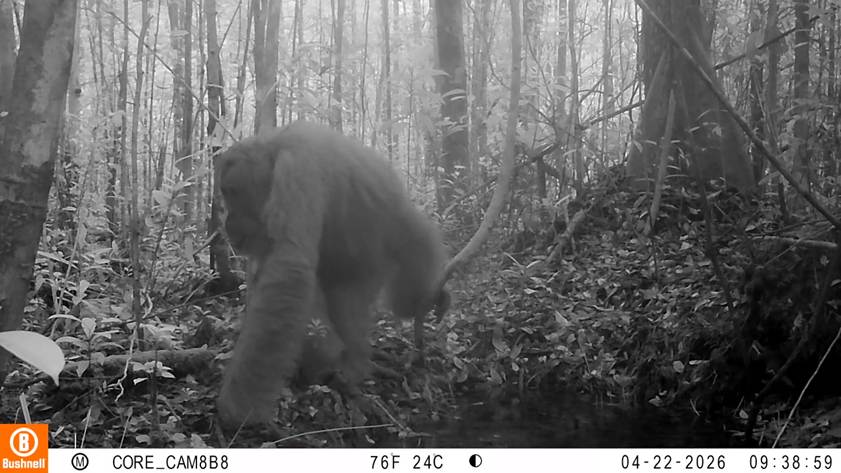
An adult Orangutan captured by a camera trap within the SBK Project area, 22 April 2026
That brief recording is one among the many traces of life documented across the South Barito Kapuas (SBK) Project, a nature-based carbon project developed by PT Nusantara Raya Solusi (NRS) in Central Kalimantan. And this 19 August, as the world marks World Orangutan Day, those traces carry a message that stirs the heart: across the Barito landscape, the Bornean Orangutan (Pongo pygmaeus) still endures, and we still hold the chance to keep it so.
A Home for the Keeper of the Forest
The SBK Project area is a living mosaic of peat swamp and secondary forest stretching along the reaches of the Barito River. It is here that the Bornean Orangutan, listed as Critically Endangered by the International Union for Conservation of Nature (IUCN) and fully protected under Indonesian law through Ministerial Regulation No. P.106/2018, has found one of the last remaining strongholds still able to sustain its way of life.
The project’s initial biodiversity surveys yielded findings that are as heartening as they are humbling: a significant potential Orangutan population, revealed by a remarkably extensive distribution of nests along the survey transects. Those nests, woven each evening from branches and leaves high in the canopy, are the primate’s signature upon the canvas of the forest; every nest is living proof that this forest breathes, and that it still provides.
The evidence deepens through a network of camera traps installed at forty stations across the project area. Through those quiet lenses, the Orangutan appears again and again: crossing the forest floor, swaying through the canopy, going about its days unaware that its presence is being faithfully recorded. Field teams, too, have met the Orangutan face to face in the secondary swamp forest, encounters that always end the same way, with respect: observing from a distance, taking careful notes, then letting the animal return to its solitude.
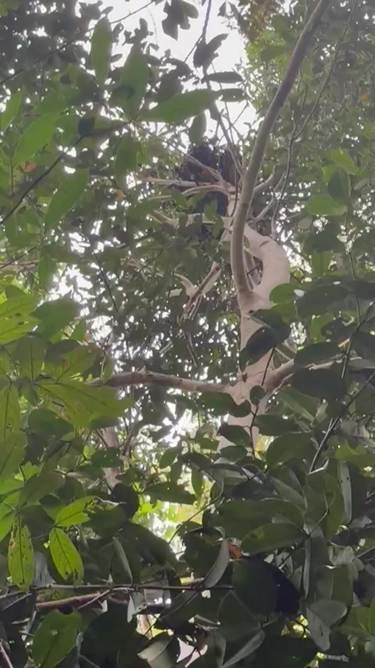
An Orangutan in the canopy, documented by the field team within the SBK Project area
Why the Orangutan Matters
Dr. Biruté Mary Galdikas, the primatologist who has devoted more than five decades of her life to the Orangutans of Borneo, has often described them as the “gardeners of the forest”, nature’s own seed dispersers, quietly tending the regeneration of the tropical rainforest. The fruit an Orangutan eats today becomes a tree that rises decades from now. To protect the Orangutan, then, is not merely to save a single species; it is to safeguard the very architecture of forest life, the carbon held within it, the water flowing from it, and the livelihoods of the communities who depend upon it.
The great naturalist E.O. Wilson reminded us that every species is an irreplaceable masterpiece of evolution. For the Orangutan, a kin who shares roughly 97 percent of its DNA with us, extinction would be more than an ecological loss; it would be the loss of part of the mirror in which we see ourselves.
SBK’s Commitment: From Data to Protection
These field discoveries do not end as entries in a scientific logbook. The SBK Project is currently preparing its Climate, Community and Biodiversity (CCB) certification, the international standard ensuring that carbon projects deliver genuine benefits for the climate, for communities, and for biodiversity. Within its biodiversity pillar, the document elevates the Orangutan as a key species whose protection is to be strengthened, and lays the foundation for a comprehensive Biodiversity Management Plan (BMP): sustained population monitoring, the protection of habitat corridors, the mitigation of human–wildlife interactions, and the meaningful engagement of villages surrounding the area.
For NRS, the presence of the Orangutan within the SBK landscape is not a burden but an honour, and a measure of success. A forest that can sustain an Orangutan is a forest in good health; and a healthy forest is the beating heart of every climate endeavour worthy of the name.
An Invitation on World Orangutan Day
The Senegalese conservationist Baba Dioum once offered words that have since become a compass for the global conservation movement: “In the end we will conserve only what we love; we will love only what we understand; and we will understand only what we are taught.”
So on this World Orangutan Day, allow us to invite you to understand, that in the heartlands of the Barito, the forest’s architect still builds its nest at every dusk; to love, for its continued existence is bound to our own; and to help protect, by supporting conservation, by turning away from products born of forest destruction, and by lending your voice within your own circle of influence.
The Orangutan asks for little. It asks only that its forest remain standing. And as long as the canopies of the Barito stay green, as long as our silent cameras keep recording its unhurried steps, that hope stays alight.
Happy World Orangutan Day, 19 August
PT Nusantara Raya Solusi — South Barito Kapuas Project
“Safeguarding carbon, sustaining life”